Discovery of the icehouse ritual site
The Pale Blue EyeThe discovery of the icehouse ritual site turns a difficult-to-see pattern of ground marks into evidence of deliberate ceremony. Working together, Augustus Landor and Edgar Allan Poe identify a circle and a triangle where Leroy Fry’s heart was removed; their reconstruction links the hidden traces to religious and occult imagery, and later events reveal that the pattern was not merely speculative. The investigation depends on a change in viewpoint: what had escaped a search at ground level becomes legible when the investigators look down and read the landscape as a record of objects that have been taken away.
Background and Method
Landor brings Poe to the area north and slightly northeast of the Icehouse door, which he identifies as the scene of the second crime: the removal of Leroy Fry’s heart. Its position seems chosen for concealment. Officers’ quarters lie northwest, the cadet barracks west, the academies south, and the guard post at Fort Clinton east. Landor reasons that this location offered the perpetrator a chance to work unseen. Although he has already searched around the Icehouse, even crawling on his hands and knees, he has not found the clue. The breakthrough comes from abandoning that familiar vantage point.
The search begins with a request for Poe to look down from above and locate interruptions in the grass or soil, especially places where a rock or stick may have been driven into the ground. Poe spots a small indentation beside Landor’s left foot, perhaps three inches across. Landor presses one of the shiny white stones he collected by the river into the crevice, making the mark easier to see. They repeat this process, with Poe directing Landor to possible gaps and sometimes revising his judgments. Their work is halting: Poe takes several minutes to begin in earnest, and the whispered instructions make it difficult for Landor to follow them. The method nevertheless turns separate impressions into a visible arrangement.
Reconstructing the Pattern
Landor’s religious hypothesis guides what the investigators look for. Leroy Fry had once associated with a disreputable group before joining the Prayer Squad, and the condition of his body had made Sylvanus Thayer think of a religious fanatic. Landor therefore considers whether the heart-removal might have been accompanied by a ceremony, with stones, candles, or other objects placed intentionally. Even if the objects were removed afterward, he reasons, their impressions might remain: the search party’s approach and the need to attend to the heart would have left little time to fill the holes. This is a theory about absent objects, not a direct observation of the ceremony, and the distinction matters to the investigation.
Using the white stones as markers, Landor scans the pale grass and plots their positions in a notebook. He moves in a wave pattern and measures the distances between the marks until the page holds a lattice of dots. Poe recognizes the outer design as a circle. Landor estimates it at ten feet in diameter, much larger than the space Fry’s body would occupy and large enough, in his vivid comparison, for several bodies. Looking again at the points within the circumference, the two men draw lines through the closest marks and recognize a triangle. Landor infers that Fry’s body had lain within it and begins to consider where the officiant might have stood, but the pattern alone does not establish who took part or precisely what happened.
A further clue comes from scorch marks that Poe recalls seeing from the roof. He shades a notebook page over the marks, bringing out what first looks like the reversed letters SHJ. When they consider that the whole message may have been reversed, Landor writes the letters out in ordinary orientation, and Poe identifies them as an inscription referring to Jesus Christ. Landor observes that the inscription was common in earlier times, though he had not seen it written backward. The discovery thus adds a Christian sign to the geometric traces, complicating any simple reading of the site as exclusively pagan or satanic.
Interpretations and Textual Clues
Landor and Poe take their drawing to Professor Pawpaw and ask what to make of it. Pawpaw gives the circle several possible meanings: an ancient Greek or alchemist might see an ouroboros and eternal unity, while a medieval thinker might understand it as creation and the void toward which creation tends. He is more decisive about the triangle within it, which he identifies as a magic circle. Drawing on Le Veritable Dragon Rouge, he describes a magician standing in the triangle, possibly with assistants, candles on either side, and a brazier in front. His account supplies a possible arrangement for the pattern, but remains an interpretation of a diagram rather than proof of the people’s actions at the Icehouse.
A passage Poe reads from de Lancre’s description of a witches’ sabbath gives the investigators a more disturbing textual association. The feast is said to include unclean animals, the hearts of unbaptized children, and the hearts of hanged men. Poe’s final item is especially suggestive because Fry had been hanged and his heart was removed. The passage intensifies the ritual hypothesis, but its force is associative: it connects a written account of occult practice to the physical facts of Fry’s death without, by itself, establishing the perpetrator’s motive or beliefs.
Confirmation and Significance
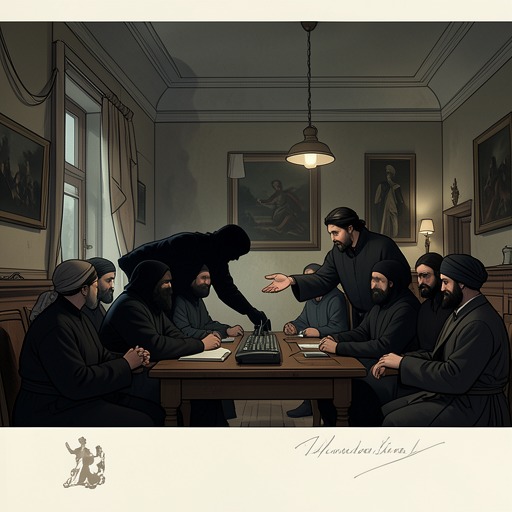
The later approach to the Marquis family’s private ceremony gives the earlier reconstruction a startling visual counterpart. In a room lit by rows of wall tapers, a circle of torches encloses a triangle of candles; a fiercely burning brazier and a pine tree braced in the stone add to the display. An inscription is etched at the triangle’s base. Three figures move among the lights: a monk in a gray homespun robe, a priest in a cassock and surplice, and an officer of the United States Army wearing what Landor recognizes as Joshua Marquis’s old uniform. This scene confirms that the circle-and-triangle arrangement belongs to an actual family ceremony, even though it does not make every earlier inference about the Icehouse self-evident.
The discovery is therefore both a piece of forensic reconstruction and a shift in how the crime can be understood. A set of small holes, first nearly invisible in the grass, becomes a map of ritual space; the reversed inscription and the texts consulted by Poe and Professor Pawpaw extend that map into religious symbolism. The contrast with the United States Military Academy’s public order sharpens the effect. During evening parade, the cadets’ companies absorb the missing place of Leroy Fry into their ranks, bridging the gap so that the formation appears whole. At the Icehouse, by contrast, the investigators find a second, concealed order marked in the ground. The ritual site makes the landscape preserve what the perpetrator tried to remove, while the later ceremony reveals how closely a family’s private performance echoes the pattern the investigators had painstakingly reconstructed.